I have struggled to truly figure out how I want to express ASL in my stories. After all, ASL is a visual language – not a written language. I’m constantly thinking:
Do I use <brackets>?
Do I use italics?
Do I use quotes – or no quotes?
Do I change the FONT?
Do I do anything different at all?
Do I use full ASL grammar and language structure, or keep the English meaning and simply add the in the author’s note that I am writing it in English?
How do I….
What should I do….
HELP.
This has been my typical thought process for at least five years. Before I became serious about finishing my stories and publishing, I simply just added the tags, “she signs” or “he signed,” to the end of a sentence.
Research Other Deaf Characters in Books
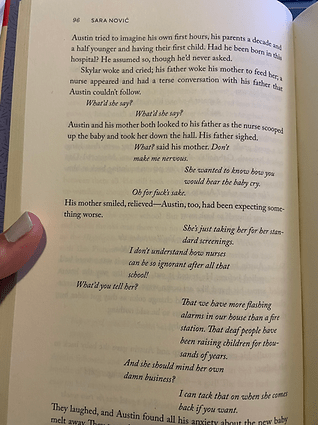
Every book that I read that has had a deaf character showed sign language differently. True Biz by Sara Nović did no quotes for speaking, and no quotes with italics for signing. She also had the characters signing placement spread out.
You’re Welcome, Universe by Whitney Gardner and Song for a Whale by Lynne Kelly, didn’t do anything special with signing – simply added the phrase, “she signs,” or similar.
Another that I read (I can’t remember the name) had [brackets] for sign language.
Deaf Utopia by Nyle DiMarco used GLOSS for signing, which has capitalized text.
For me, reading short sections of GLOSS is alright, and I know this is a big part of Deaf culture and ASL, however, for me, reading the entire book in GLOSS feels like the characters are screaming at me.
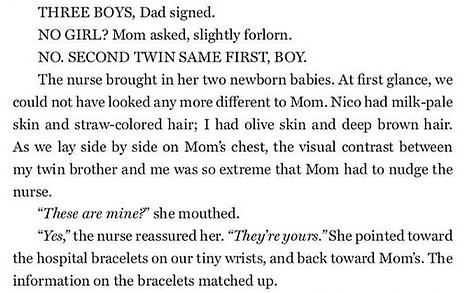
Recently, I’ve read a couple of books that have a different font for showing either sign language (Next of Kin by Hannah Bonam-Young) or simcomming (simultaneous communication). I’ve actually found that I enjoyed reading it this way. Additionally, there could be multiple ways of communication within the book. A.C. Nightingale illustrates that this can be done in her book The Daisy Chain Collapse. She used bold for signing, and a different font for simcomming.
Showing ASL in My Book(s)
But, finally, after much debating with my writing group, deaf friends, interpreter friends and the DEAFinitely Readers book club, I will be showing sign language a couple of different ways in my writing:
- ASL will be italicized and quotes
- SimCom, which is simultaneous communication, will be quotes and a different FONT with a tag of either “simcom” or “simcomming”
- English will be just with quotes with regular tags of “said,” “yelled,” etc.
And I felt validated when I came across this article about ASL: Writing a Visual Language by Laura Brown, a Hard-of-Hearing author, that gave so much information plus her recommendations.
Showing Gaps in Spoken Language
One of the things that I will also be showing in any of my writing is if a d/Deaf and/or Hard-of-Hearing character is speaking with a hearing characters, there may be “gaps” in the conversation.
For example, here is an example of my book:
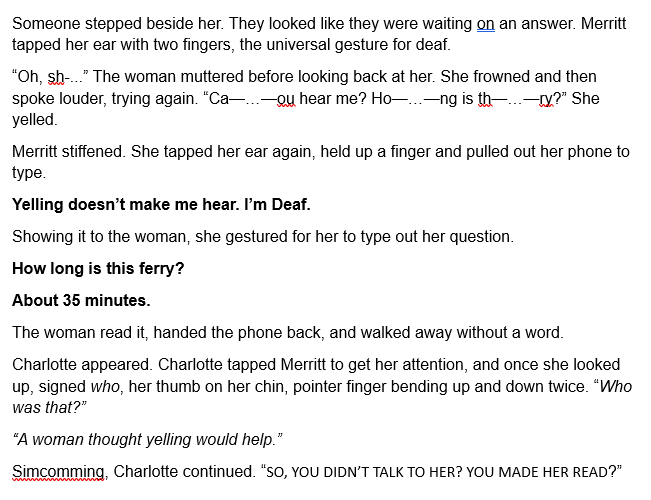
Sometimes, I may also add in a similar [mumble] like in Deaf Utopia: “[mumble mumble] hearing frequency [mumble mumble].” (pg. 4)
However, after the “initial” gaps during the conversation, I will typically show the entire conversation, unless someone comes up behind my character(s); it will not continue to be constantly missing letters.
A Note of Warning to Hearing Authors
Another thing I’ve noticed is that hearing loss and sign language are oftentimes not presented as a normal variation for a character. Rather, they’re the alluring secret from the first few pages and you have to keep reading until, surprise, the character’s deaf! A gimmick. I have a hearing loss. I’m not a gimmick. I’m me. My ears are part of me. They affect me every day. Yes, at times I would hide them, but why is it a dirty little secret in literary form?
And that’s the thing with sign language—it comes with a culture. Many people with a hearing loss are not given sign language at birth or at onset of hearing loss. There’s a journey each of us go through to arrive at a fluent status. I’m Hard of Hearing. I speak, so I can communicate verbally. But ASL also helps me communicate. I chose to do so, and the fact that I sign is why I capitalize Hard-of-Hearing; I’m part of the culture.
As you’re probably already aware, I am highly passionate about reading (and writing), along with hearing loss, ASL (any sign language), and Deaf Culture. I love finding books that have characters I can truly connect to – and I hate when I hesitate to pick up a book because I worry about being disappointed in the character.
I’ll give two quick examples, as I’ve had the privilege of being a Deaf Sensitivity reader to several authors in the past two years. They are doing their research, making sure that their characters are true representations of Deaf experiences and culture.
For Samantha Christy, a hearing author, on her book Quiet, Beautiful Things – she did her research, took feedback, and made changes to her book to make sure that she represented her Deaf characters Ellie and Maisy as authentically as possible.
On the other side, I read a book (I was not a sensitivity reader for), A Song Below Water, that stated it had “ASL representation” only to have that book maybe use ASL a handful of times, and the character “pretending” to have a disability where she wouldn’t speak and was non-verbal. Being non-verbal and selective mute is a REAL disability but how this was handled… it was not the actual disability. This is not appropriate, and I struggled with finishing the book because I was angry with how a disability was added to the book just open the book up to another community. It took me back to another book I read where the character was “deaf” but no research, or getting a Deaf sensitivity reader as done to show a true representation.
So, my warning to hearing authors: make sure that you are truly representing the Deaf community well and for the right reasons (ask yourself why you are writing this character). I’ve mentioned it before, and I’ll mention it again, I’m happy to be a Deaf Sensitivity Reader for you – simply reach out to me. I have other friends who enjoy it as well. I want all books that will have Deaf, Hard-of-Hearing, Deaf-Blind, sign language, etc. to be a real representation, not just to have the label that the character is “deaf”.
I love to add more books with Deaf characters and representation to my book list as well as have the DEAFinitely Readers Book Club I co-host read and spread interest on your books. I simply don’t want to pick up the book, excited to read it, only to be disappointed that the way the character and community is represented is weak and a disappointment.
ASL and Stories
I didn’t mean to deviate off my original post. It did need to be written, and it is something I am very passionate about – not just for the Deaf Community but for any marginalized communities. For any authors (including myself) make sure that you do your research if you have a character that is part of a marginalized community (from Deaf to POC to chronic illness, etc.) and have sensitivity readers.
As for me, even though I am part of the Deaf Community, I still plan on having Deaf Sensitivity readers read my book and give feedback. After all, I am only a part but I want to write characters who readers can truly connect with – a strong but vulnerable character who is also Deaf/Hard-of-Hearing. After all, deafness is just another aspect for my characters, but that is not only who they are.
So, at the start of my books, there will be a page that lets the reader know how sign language will be written. And my goal, as always, will be to write regular books where the characters have adventures, could be magical, but are also, Deaf.
Happy Writing!


Leave a comment