For November, DEAFinitely Readers read Affogato by E.M. Lindsey, the first book in the BrewBiz series. I also went on to read the second book, London Fog.
Both books feature Deaf representation and LGBTQIA+ representation, and overall, I felt the LGBTQIA+ rep was well done. Most of the characters are queer, some are trans, and there are thoughtful discussions about how identity doesn’t always fit neatly into predefined boxes. The books acknowledge that you can be part of a community without fitting perfectly into a specific gender or sexuality label, and that identity is often about how you feel and choose to identify, even if it doesn’t match someone else’s definition (for example, grayromantic vs. aromantic).
Deaf Representation
The author used sensitivity readers, and it shows. A lot of research clearly went into the Deaf representation, and many moments felt authentic – those “yes, we do that” or “no, we don’t” moments that stand out to Deaf readers. Nearly all of the characters are Deaf or hard of hearing, and there’s a spectrum represented: cochlear implants, hearing aids, oral communication, generationally Deaf characters, Deaf raised by hearing parents, and more. Some characters sign, some use SimCom, and others navigate different communication preferences. The variety of Deaf experiences is one of the strongest aspects of the series.
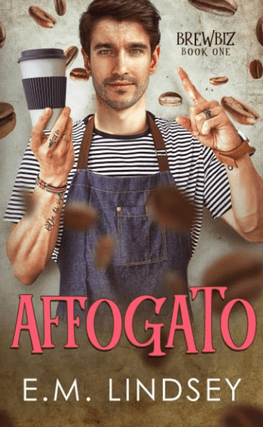
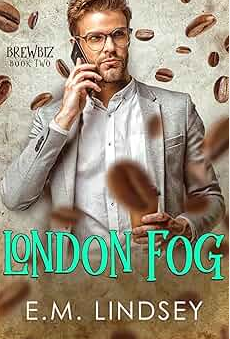
The series follows two brothers: Caleb and Wren.
In Affogato, we follow Caleb. He was born Deaf to hearing parents, had a cochlear implant that “failed,” and was ultimately raised Deaf. He attended a Deaf school, signed his entire life, and has strong Deaf pride.
In London Fog, the focus shifts to Wren. Like Caleb, he was born Deaf, but his cochlear implant was “successful.” He was raised hearing, went through speech therapy, attended a mainstream school, and learned sign language later in life. Wren clearly felt caught between the Deaf and hearing worlds, never fully belonging to either. He also believes that Caleb doesn’t truly understand his struggles, because so much of the conversation around Deafness in their relationship comes down to what Wren can or can’t “hear.”
I really appreciated seeing these contrasting perspectives between the brothers. Caleb’s Deaf pride is powerful, but at times it becomes a flaw as he can be dismissive of Wren’s experiences, as well as the struggles of his love interest, Bodhi, who is autistic and finds learning sign language difficult. That tension made the representation feel realistic and human rather than idealized.
However…
These books are very spicy, and I did not expect that going in. Since this was a book club pick, it was a learning experience for me, and going forward, I’ll be doing more research on spice levels before selecting reads.
There is a lot of sex. For me, the heavy emphasis on spice ended up overshadowing the Deaf, LGBTQIA+, and autistic representation, as well as the emotional depth of the story. By the final third of both books, once the couples (Caleb/Bodhi and Wren/Percy) were together, the plot largely stalled and was replaced almost entirely with sex scenes. Personally, I felt those sections could have been significantly reduced without losing anything meaningful from the story.
Notable Quotes
Affogato
- “They were family after all. They wouldn’t just die for each other, they would live for each other.”
- “Keep people around you who are willing to be patient for you and remind people of your worth who aren’t.”
- A funny and very accurate line: “Deaf people gossip worse than a Victorian knitting circle.”
- “He and Ravi never lost anything; they’d just been forced to try to gain something that didn’t belong to them, that wasn’t meant for them.”
London Fog
- “The right person won’t see you as hard work. They’ll see you as worth it.”
- “He once again appreciated living in a Deaf house and existing in a Deaf space that didn’t have the expectation he push himself through discomfort for others.”
Final Thoughts
One thing I didn’t particularly like that was mentioned in the author’s note: ASL is treated as the primary language and shown as regular dialogue. In and of itself, this is fine – and its something I’ve even considered for my own writing. However, in the book, spoken English wasn’t clearly differentiated, and I sometimes struggled to tell who was signing versus speaking. Especially since at the beginning Bodhi spoke more than signed.
That said, I did appreciate how ASL slang was incorporated and presented throughout the books.
If you don’t mind very high spice and are looking for a romance with Deaf, LGBTQIA+, and autistic representation, this series may be a good fit for you….just go in knowing what to expect.
Happy Reading!


Leave a comment